
Contents
This long form guide explains how forex markets operate across Saudi Arabia and the Gulf neighbourhood, what the regulators require, practical steps for traders, and the cross border issues you need to watch. The tone is straightforward and dry, aimed at readers who already know the basics of forex but need a clear map of rules, risks and local practice. Expect practical detail rather than cheerleading.
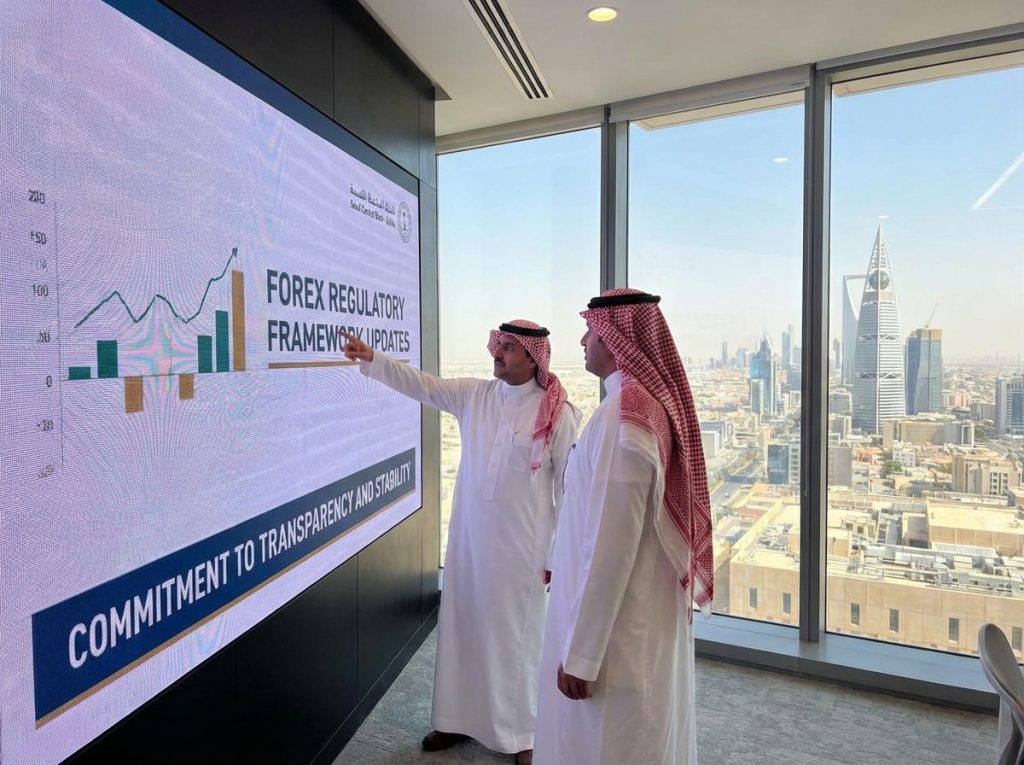
Saudi Arabia does not operate a single, casual permission model for financial activity. Two public authorities matter most: the Capital Market Authority which oversees capital markets rules and licensing for market intermediaries, and the Saudi Central Bank (SAMA) which oversees banking, payments and money service providers. The CMA administers the legal regime for entities conducting capital markets business in the Kingdom and requires authorisation for persons doing regulated securities activity. At the same time SAMA’s rulebook places explicit restrictions and monitoring over transfers linked to foreign currency trading companies and unlicensed money changing activity, so payment routes used to fund trading accounts are actively subject to bank controls and compliance checks.
Put simply: trading forex is not a blank permission. Retail activity is possible in practice — many residents trade through international brokers — but doing so inside the Kingdom means you must consider both securities rules (CMA) and banking/payment rules (SAMA). The regulators have been updating frameworks recently as part of broader capital market reforms, and those changes are changing market access for both local and foreign investors.
You can find broker regulated in Saudi Arabia by visiting ForexBrokersOnline.
If you live in Saudi Arabia and want to trade currency pairs, these are the main practical points you’ll meet. First, verify the broker’s regulatory status. Prefer brokers with clear, reputable licences and documented compliance policies; if a provider claims to be “licensed in Saudi” ask for the license reference and check the CMA register or the broker’s public disclosure. Second, banks will scrutinise transfers intended for forex trading and may halt or return transactions that appear directed to unlicensed currency trading companies, so plan funding routes with that in mind and expect KYC and source of funds checks. Third, standard retail protections — segregation of client funds, negative balance protection, transparent pricing — remain the best practical signals of a serious provider, even if the broker is licensed offshore. Finally, regulatory changes in early 2026 have further opened market access in some areas, so the space is moving; keep an eye on CMA and SAMA announcements.
Choose a firm that provides full disclosure about jurisdiction, client money rules, order execution, fees and margin calls. Many Gulf traders still use internationally regulated platforms rather than local-only firms for reasons of liquidity and product range. If you prefer local presence, confirm the local entity’s licence and read its terms — in many MENA markets licensed brokers must apply specific client suitability standards and capital requirements. On account type, look for an Islamic or swap free option if you need Sharia compliance, and for clear rules around leverage and margin because regulators in the region often require lower leverage or extra disclosure for retail clients.
Religious compliance matters for many traders in the region. Opinions vary among scholars and Sharia advisory boards: spot currency dealings are often treated differently from leveraged CFD or margin contracts. Brokers that offer Sharia compliant accounts typically remove overnight swap interest and provide alternative financing arrangements, but such accounts also come with different pricing and sometimes additional fees. If Sharia compliance is a firm requirement for you, request the broker’s fatwa or Sharia board statement and assess the contract mechanics rather than relying on marketing labels. Scholarly and industry write ups on Islamic finance and retail FX highlight the nuance: whether a transaction is acceptable may depend on structure not just label.
Regulation in the Gulf and Levant is not uniform. Below is a concise comparison of the main neighbours you’re likely to consider.
UAE — The UAE offers a layered regulatory model with multiple licensing zones (onshore plus financial free zones such as ADGM and DFSA) that host internationally licensed brokers and funds. Free zone regulators apply common law style rulebooks, and many reputable international brokers establish a presence in ADGM or DIFC to serve regional clients. If you target UAE liquidity or presence, ADGM/DFSA regulated entities provide clearer recourse and internationally familiar rulebooks.
Bahrain — Bahrain’s Central Bank is the integrated regulator and maintains a transparent rulebook for financial institutions, including licences for brokers and investment firms. Historically Bahrain has been active in licensing forex and CFD providers aimed at MENA clients and remains a common regional hub for brokers.
Qatar, Kuwait, Oman, Jordan — each jurisdiction has a functioning regulator and differing tolerance for retail CFD or crypto products. Qatar operates a tightly controlled regime in its financial centres; Kuwait and Oman have active central banks tightening controls on informal currency exchanges; Jordan has strengthened licensing for market intermediaries. The practical consequence is that product availability, local deposits and the ease of opening a locally licensed account differ materially across these states, so always check the local regulator’s published rulebook before assuming a service is offered the same way it is elsewhere.
Banks enforce AML and CTF rules strictly. Transfers intended for forex trading can be returned, blocked or subjected to additional paperwork where the counterparty lacks a clear licence or where the transfer patterns look like rapid, repeated funding and withdrawals. Use regulated payment rails, document source of funds, and be ready for identity verification and proof of residency. This is not optional; banks and payment processors are under tight oversight, and the SAMA rulebook explicitly addresses inbound and outbound transfers linked to currency trading entities.
Expect lower leverage and more conservative margining with locally authorised products compared with some offshore offerings. Regulators across the Gulf have erred on the side of retail protection in recent years, so retail leverage caps and increased disclosure are common. If you use an international broker, compare the effective margin requirements, execution speed and slippage behaviour under real market stress, not only the advertised spreads in quiet conditions.
Saudi Arabia does not impose a general personal income tax on employment income, and for many retail traders there is no domestic personal income tax on trading profits as a routine matter. That said corporate tax rules, zakat, withholding obligations and tax treatment of non resident gains vary depending on your residency, the legal structure you trade through and the instruments used. For tax-sensitive matters, rely on a licensed tax adviser because the distinction between personal trading, professional trading within a business and cross border withholding can create different liabilities. For quick reference, major international tax guides and advisory firms note Saudi Arabia’s absence of a conventional personal income tax while flagging corporate tax and capital gains rules for non residents.
This article was last updated on: January 23, 2026